I ran an after-school AI club
Today was the last session of an after-school AI club I ran this semester. I’ve never been a tutor, but I’ve helped a lot of people study, and they’ve often told me I’d make a good teacher. I wasn’t sure, so this was my chance to find out.
It was part of a module at the University of Birmingham called Teaching Computer Science in Schools. Most people on it spend eight school days teaching lessons already planned for them. I joined the university’s outreach programme instead, and ran four after-school sessions for Year 7 to 9 students at an all-girls secondary school in Birmingham. Phones aren’t allowed at school, and laptops only come out in a few lessons a week, so hands-on time with tech was rare for most of them.
Nobody handed me a lesson. What to teach, and how, was up to me, and so was everything that came with it: the slides, the games, the printouts and the VR headsets, all sent to the school to review in advance. Making something as hard as AI fun took far more time than I expected, all of it alongside my thesis.
I didn’t know their ages or what they’d already learned, so I had to guess how far to simplify. By the first session I was the most tired I’d been all semester. And the professor, who was meant to introduce me, couldn’t make it. A man leading the room was unusual for them, so without her it was much harder to make a good first impression. Once it started, the energy came, but it still went badly. I learned more from watching that room than from all my planning, and from then on, every idea became a game they could play and work out for themselves.
Four sessions
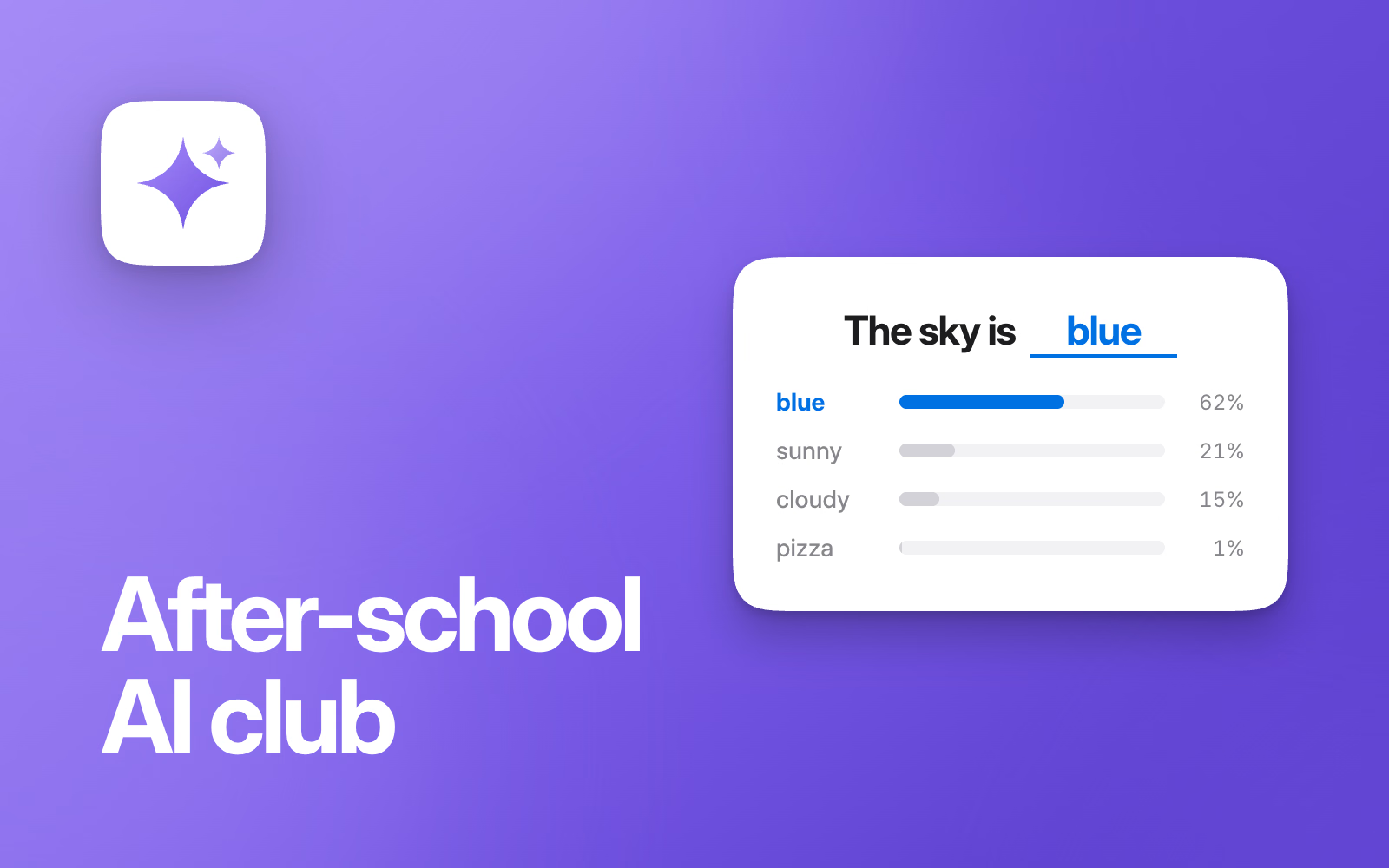
- AI: the mind of a machine. It was too technical, and my slides lost them. What won them back was a game: eyes closed, each adding one word to a sentence, the way ChatGPT does. Mostly they tried to trip each other up.
- Outsmarting AI. Scams and deepfakes. We played Chinese Whispers, with the teacher secretly playing a man-in-the-middle attack, like the impostor in Among Us. They loved finding out, and asked to play again. Then they spotted scams, and the hard ones had them out of their seats, arguing at the board. Some stayed late to finish a round of Quick, Draw!, where an AI tries to guess your doodle.
- How machines see. Computer vision: optical illusions, how Face ID maps a face, a driving game you steer with your face, and Meta Quest headsets I borrowed through the university’s VR Society, with everyone rotating between stations. A few found the advanced VR demo too much, so I started everyone on the simple one.
- The future of AI. Bias, what AI might help with, and whether it will take over. Then they trained their own AI with Google’s Teachable Machine, to tell a thumbs up from a thumbs down, who was in front of the webcam, and what they were wearing.
The hardest scam round was two websites that looked exactly the same. The lesson was to trust your gut: if something feels off, look closer. Try it, with a few more tricks than the class got.
Spot the fake. One of these is a scam. 1 of 4
Tap the one you think is fake.
You got it. The fake swaps the a for ɑ, the one you write by hand. To a computer it’s a different letter, so it’s a different website.
Tap the one you think is fake.
You got it. The fake uses an r and an n squashed together. At a glance, rn looks just like m.
Tap the one you think is fake.
You got it. The fake ends in a capital i instead of a lowercase L. In the font on this page, and lots of others, the two look exactly the same.
Tap the one you think is fake.
You got it. The fake starts with royalmail.com, but what counts is how the address ends, just before the first slash. This one is really parcel-help.co.
Nobody had to come. Half an hour into the first session, some of them were dozing off. By the third, every student was joining in, and the teacher had to tell them off for staying fifteen minutes late while their parents waited outside. Today, they kept asking when I’m coming back.
What I learned
Preparation is most of it, and most of preparation is understanding who you’re teaching, and meeting them at their level. I guessed wrong the first time.
Slides rarely work, at the end of a school day or any other time. Something interactive and simple, in small pieces over time, beats one big dose of information, however well it’s structured.
I also learned to stop over-helping. Giving the answer too quickly takes away the part where they work it out. And my questions were too closed. Simpler, more open ones got far more answers.
The school’s keeping my slides and games to use again. So, would I make a good teacher? Given enough time to prepare, I think so.